MORTGAGE EXPLAINED
HOW DOES A MORTGAGE REALLY WORK IN NIGERIA?

Introduction
You have found a house you like. It costs ₦50 million. You do not have ₦50 million sitting in your bank account. Does that mean you cannot become a homeowner?
Not necessarily.
This is where mortgage finance comes in.
For many Nigerians, the dream of owning a home comes with a difficult question: “How can I afford to pay for a house?” A mortgage can provide a structured way to finance a home and repay the cost over an agreed period.
But what exactly is a mortgage? How does it work? Who is involved? What do you actually repay? And what happens if you cannot keep up with your repayments?
Let's break it down.
1. What is a mortgage?
A mortgage is a form of long-term financing used to purchase, construct or improve a property, depending on the mortgage product and its terms.
In a typical home-purchase mortgage, a lender provides money to help finance the property. You contribute part of the cost, where required, and repay the amount borrowed, together with interest and applicable charges, over an agreed period. The property generally serves as security for the loan.
Simply put: A mortgage lets you buy a home today and pay for the financing over time, rather than paying the entire purchase price upfront. Mortgage finance therefore bridges the gap between a home's price and the money a prospective homeowner has immediately available.
However, a mortgage is not free money. It is a long-term financial commitment you should fully understand before you sign an agreement.
2. How does a Mortgage Work?
Let's return to our ₦50 million house.
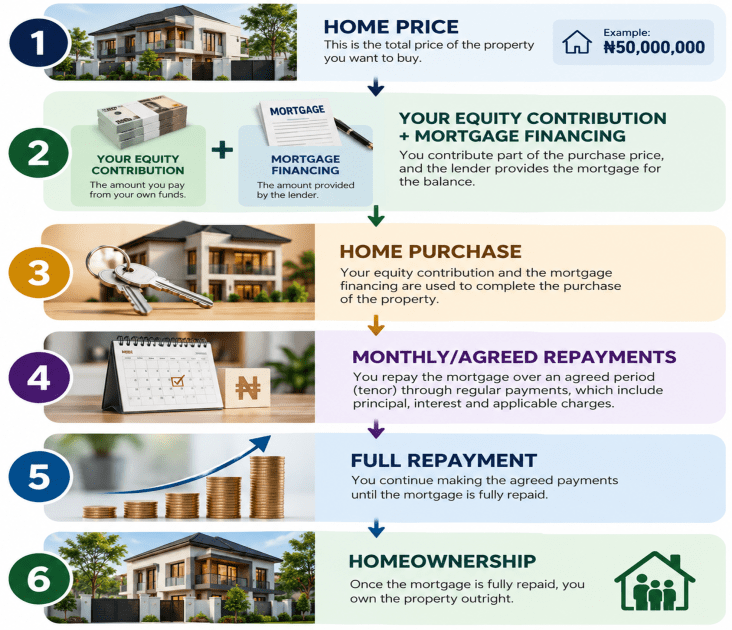
Suppose, purely for illustration, that you have ₦15 million available and need financing for the remaining ₦35 million. The basic structure is:
House price → Equity contribution → Mortgage loan → Repayments → Full repayment
In our example:
- Property price: ₦50 million
- Your contribution: ₦15 million
- Mortgage financing: ₦35 million
The lender provides the mortgage financing, subject to its assessment, terms and conditions. You then repay the mortgage according to the agreed schedule. Your repayment generally covers principal—the money borrowed—and interest—the cost of borrowing. Other applicable charges may also arise depending on the mortgage product and lender.
In essence, you use mortgage finance to help acquire the property and repay the financing over time.
3. Who is Involved in a Mortgage Transaction?
Although the borrower and lender are central to the transaction, several other parties may be involved.
The Homebuyer: You—the person purchasing or financing the home. You provide the required information and documentation and meet the agreed repayment obligations.
The Mortgage Bank/Lender: The lender provides the financing, subject to its eligibility requirements, credit assessment, property requirements and other conditions. It also determines the applicable interest rate, tenor, repayment structure and charges.
The Developer or Vendor: The person or organisation selling the property to you.
The Valuer: A professional who may assess the property's value and suitability as security for the mortgage.
The Solicitor: Legal professionals who may conduct due diligence, review property documentation and prepare or perfect relevant legal documents.
The Insurer: Depending on the mortgage arrangement and applicable requirements, insurance may form part of the transaction.
Each plays a different role in completing the mortgage transaction.
4. What are you Actually Repaying?
Your mortgage payment is not simply a repayment of the house price. There are three broad components to understand:
Principal or Capital
The amount you borrowed. If you borrow ₦35 million, the initial principal is ₦35 million.
Interest
The cost of borrowing the money. The amount depends on factors including the amount borrowed, the interest rate, the repayment structure, and the tenor.
Applicable Charges
Depending on the product and lender, there may be valuation, legal, administrative, insurance or other applicable costs.
This is why you should not look at an advertised interest rate alone. Before committing to a mortgage, understand the total cost, repayment obligations and terms and conditions.
5. What is Mortgage Tenor
The tenor is the period over which the mortgage is scheduled to be repaid.
Depending on the product and borrower's circumstances, a mortgage could have a tenor of 5, 10, 15 or 20 years, subject to the lender's terms and applicable requirements.
Tenor matters because it affects your repayment. Generally, a longer tenor can reduce periodic repayments because it spreads the cost over a longer period. However, you may pay interest for longer, increasing the total financing cost. A shorter tenor may mean higher periodic repayments but less interest over time.
However, the mortgage with the lowest monthly payment is not necessarily the mortgage with the lowest total cost. Therefore, consider affordability alongside the total cost of borrowing.
6. Why Does the Property Serve as Security?
You may wonder, “If I am buying the house, why does the lender need the property as security?”
A mortgage involves the lender providing a substantial amount of money upfront while the borrower repays it over many years. The property secures that financing. This does not mean the lender simply takes your house because you miss one payment. The mortgage agreement establishes the rights and obligations of both parties, including what happens in the event of default. If you experience financial difficulty, act early. Contact your lender rather than simply stopping payments.
Before signing, understand:
- What happens if a payment is missed?
- What charges may apply?
- What happens in prolonged default?
- What options may be available to the borrower?
- What are the lender's rights under the agreement and applicable law?
Persistent or serious default can ultimately put the property at risk because it serves as mortgage security.
A Simple Nigerian Example
Imagine that you want to purchase a property for ₦50 million.
For illustration only:
| Item | Illustrative Amount |
| Purchase price | ₦50,000,000 |
| Your equity contribution | ₦15,000,000 |
| Mortgage amount | ₦35,000,000 |
| Illustrative tenor | 15 years |
| Illustrative interest rate | 15% p.a.* |
Under an illustrative monthly reducing-balance repayment structure, a ₦35 million mortgage at 15% per annum over 15 years would produce a monthly repayment of approximately ₦489,000, before separate applicable charges or insurance.
Over 15 years, total scheduled repayments would be approximately ₦88 million, of which roughly ₦53 million would represent interest.
The lesson is important: The amount you borrow is not the same as the total amount you eventually pay to finance the borrowing. Actual figures will depend on the lender, interest-rate structure, tenor, fees, repayment method and contractual terms. Always ask for the complete repayment schedule before committing to a mortgage.
A mortgage is therefore more than simply borrowing money. It turns a homeownership aspiration into a structured financial plan.
Before You Take a Mortgage, Ask These Questions
Before signing a mortgage agreement, make sure you understand:
- How much am I borrowing?
- How much do I need to contribute?
- What is the interest rate and how is it calculated?
- What will my periodic repayment be?
- How long will I repay the mortgage?
- What fees and other costs apply?
- Is the interest rate fixed or variable?
- What happens if I miss a payment?
- Can I repay early, and under what conditions?
- What is the total amount I am expected to repay?
If you cannot explain the answers to these questions in your own words, you may not yet be ready to sign the mortgage agreement.
Take the time to ask questions and seek appropriate professional advice where necessary.
Mortgage Finance: A Tool for Homeownership
A mortgage can be an important tool for helping Nigerians achieve homeownership; but it should not be viewed simply as “money to buy a house.” It is a long-term financial commitment. The right question is therefore not just: “Can I get a mortgage?” You also need to ask: “Can I comfortably and sustainably repay this mortgage?” Understanding how mortgages work is the first step. The next step is understanding what you can realistically afford.